
AmorphGen

AmorphGen

Automated amorphous structure generation using machine-learning and classical interatomic potentials.

GitHub

AmorphGen exposes three routes to amorphous structures: random placement from just a chemical formula, melt-and-quench MD from a crystal, and a hybrid workflow that anneals disordered inputs. All three are powered by universal machine-learning interatomic potentials (MACE, CHGNet, SevenNet) or classical force fields (Buckingham, Lennard-Jones).
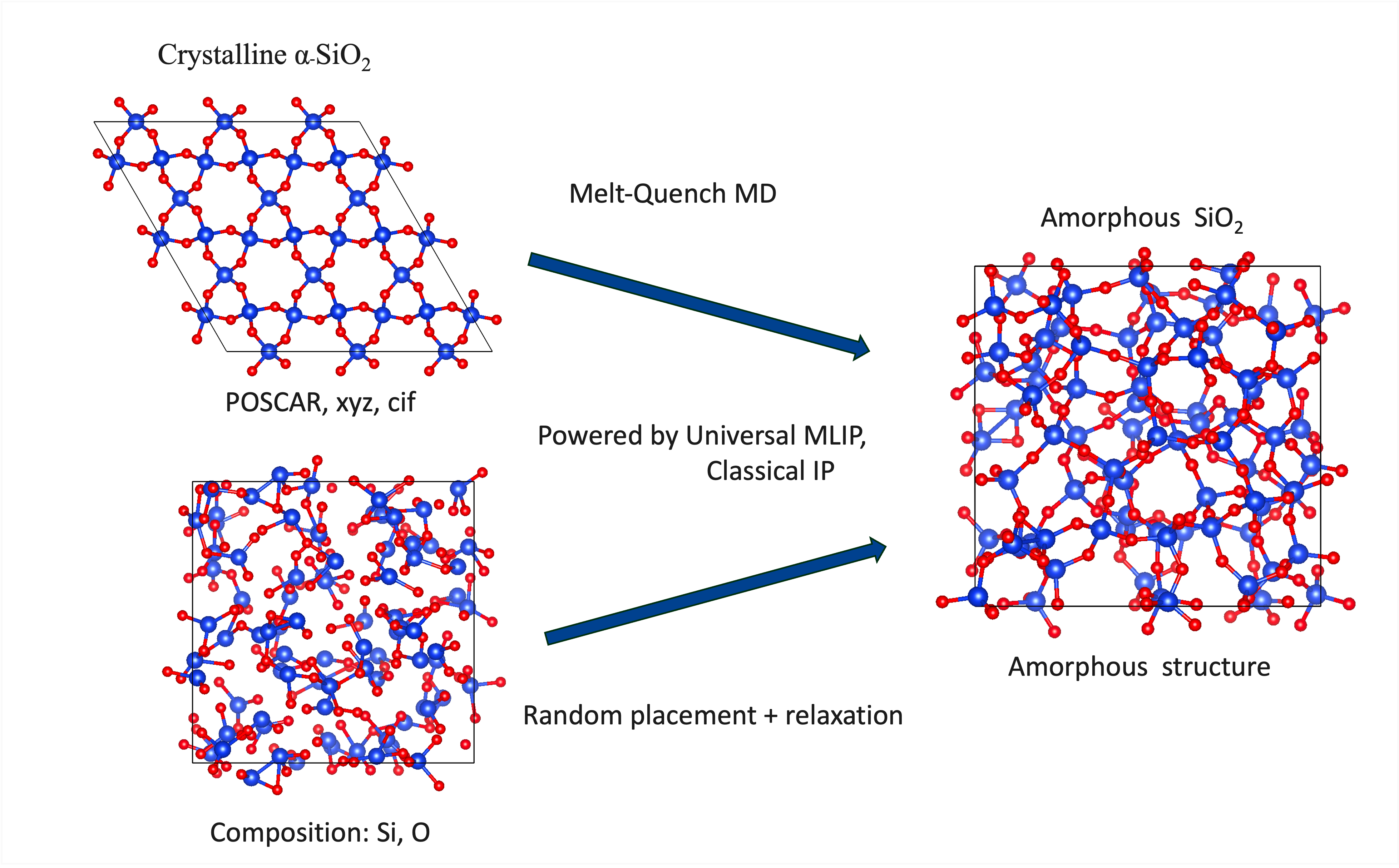
AmorphGen workflow: crystalline input or composition to amorphous structure

Why AmorphGen?

Amorphous materials play a key role in a wide range of technologies, including transparent conductors in displays, gate dielectrics in transistors, solid electrolytes in batteries, and chalcogenide phase-change memory. Generating realistic structural models of these materials usually requires writing custom MD scripts, choosing interatomic potential parameters for each new system, and managing a multi-stage simulation workflow. Existing tools force a trade-off: AIMD gives accuracy but is too expensive for screening; classical MD is fast but needs a fitted potential per composition; random-structure search tools were designed for crystalline systems rather than disordered solids.

AmorphGen simplifies amorphous structure generation by combining machine-learning interatomic potentials with an automated workflow. Users can provide a chemical formula or a crystalline structure, and the package runs a random-placement plus relaxation workflow, or a 7-stage melt-quench protocol with minimal CLI call. Calculator backends include MACE, CHGNet, and SevenNet, and classical pair potentials (Lennard-Jones, Buckingham+Coulomb) for systems where a fitted potential is preferred. All parameters – including minimum separations, density, temperatures, and cooling rates – are set automatically but can be overridden via CLI flags or YAML configuration.

The output is a relaxed amorphous structure, the full MD trajectory, and built-in structure analysis tools. Outputs are written in VASP, CIF, and extended XYZ formats, ready as input for DFT property calculations (electronic structure, optical, mechanical) or as a starting point for further structural relaxation at higher levels of theory.

Designed for researchers interested in modelling amorphous systems, including oxides, glasses, chalcogenides, nitrides, halides, and other disordered solids. Typical uses include preparing structures for DFT calculations, screening across compositions, and direct property prediction. The package has been applied to oxides (e.g. SiO₂, In₂O₃, TiO₂, Ga₂O₃, Al₂O₃, InGaZnO₄), halides (e.g. LiF, Li₂ZrCl₆), pnictides (e.g. GaAs), group-IV semiconductors (e.g. Si), nitrides (e.g. GaN, BN) and other compositions.


Get started

pip install "amorphgen[mace]"

# Generate 1 random In2O3 structure (80 atoms, VASP format)
amorphgen --random-gen --composition "In2O3*16" -n 1 --format vasp

# Generate and relax with MACE
amorphgen --random-gen --composition "In2O3*16" --relax --device cpu --format vasp

# Generate 20 structures for ensemble statistics
amorphgen --random-gen --composition "In2O3*16" -n 20 --format vasp

See the Installation and Quickstart guides for full details.


What it does

AmorphGen exposes three workflows. Pick the one that matches your starting point:

1. Random generation

--random-gen

Place atoms into a cubic cell with automated minimum separations, density, and target CN from Shannon ionic/metallic radii. Optional relax with any backend.

2. Melt-and-Quench (MQ)

--mq-ensemble (or default)

7-stage MD pipeline starting from a crystal: optimise → pre-eq → heat → high-T eq → quench → low-T eq → final optimise.

3. Hybrid

--hybrid-ensemble

Anneal a directory of disordered structures (e.g. random-gen outputs) through stages 4–7. Cheaper than MQ — skips the slow heat ramp.

MLIP and Classical Potentials

Swap calculators with a single flag. Supports MACE, CHGNet, SevenNet (MLIPs) and Lennard-Jones, Buckingham+Coulomb (classical).

Structure Analysis

RDF, coordination numbers, bond angles, ring statistics, energy ranking. CLI or Python API.


Pipeline overview

1. Random generation (--random-gen)

Composition  (e.g. "In2O3*16"  or  In=32,O=48)
         │
   ┌─────▼──────────────────────────────────────────┐
   │  Auto-derive  minsep, density, target CN       │
   │  from Shannon ionic / metallic radii           │
   └─────┬──────────────────────────────────────────┘
         │
   ┌─────▼──────────────────────────────────────────┐
   │  Random / coordination-aware placement         │
   └─────┬──────────────────────────────────────────┘
         │
   ┌─────▼──────────────────────────────────────────┐
   │  Optional relax  (--relax)                     │
   └─────┬──────────────────────────────────────────┘
         │
   N amorphous structures  (.xyz / .vasp / .cif)

See Random structure generation.

2. Melt-quench (MQ)

Crystalline input  (POSCAR / .xyz / .cif / .extxyz)
         │
   ┌─────▼──────────────────────────────────────────┐
   │  Stage 1  Structure optimisation               │
   │           optimizer + cell_filter              │
   └─────┬──────────────────────────────────────────┘
         │
   ┌─────▼──────────────────────────────────────────┐
   │  Stage 2  Pre-melt equilibration at T-low      │
   │           NVT/NPT                              │
   └─────┬──────────────────────────────────────────┘
         │
   ┌─────▼──────────────────────────────────────────┐
   │  Stage 3  Melt  –  NPT/NVT heat ramp           │
   │           T-low → T_melt                       │
   └─────┬──────────────────────────────────────────┘
         │
   ┌─────▼──────────────────────────────────────────┐
   │  Stage 4  High-T equilibration   T_melt        │
   │           NVT/NPT                              │
   └─────┬──────────────────────────────────────────┘
         │
   ┌─────▼──────────────────────────────────────────┐
   │  Stage 5  Quench  –  NPT/NVT cooling ramp      │
   │           T_melt → T-low                       │
   └─────┬──────────────────────────────────────────┘
         │
   ┌─────▼──────────────────────────────────────────┐
   │  Stage 6  Low-T equilibration   T-low          │
   │           NVT/NPT                              │
   └─────┬──────────────────────────────────────────┘
         │
   ┌─────▼──────────────────────────────────────────┐
   │  Stage 7  Final optimisation (amorphous)       │
   │           optimizer + cell_filter              │
   └─────┬──────────────────────────────────────────┘
         │
   stage7_opt.cif  +  stage7_opt.xyz

--mq-ensemble extends MQ: stages 1–4 run once, then N independent quenches (stages 5–6–7) are launched from snapshots of the stage-4 trajectory. See Melt-and-quench pipeline and MQ-ensemble workflow.

3. Hybrid: random → MQ stages 4-7 (--hybrid-ensemble)

Directory of disordered structures  (e.g. --random-gen outputs)
         │
   ┌─────▼──────────────────────────────────────────┐
   │  Stage 4  High-T equilibration   T_melt        │
   │           NVT/NPT,  20+ ps                     │
   └─────┬──────────────────────────────────────────┘
         │
   ┌─────▼──────────────────────────────────────────┐
   │  Stage 5  Quench  –  NPT/NVT cooling ramp      │
   │           T_melt → T-low                       │
   └─────┬──────────────────────────────────────────┘
         │
   ┌─────▼──────────────────────────────────────────┐
   │  Stage 6  Low-T equilibration   T-low          │
   │           NVT/NPT                              │
   └─────┬──────────────────────────────────────────┘
         │
   ┌─────▼──────────────────────────────────────────┐
   │  Stage 7  Final optimisation (amorphous)       │
   └─────┬──────────────────────────────────────────┘
         │
   N amorphous structures  (one per input)

See Hybrid workflow.


Key features

  • Random structure generation – generate amorphous structures from just a chemical formula (e.g. to model amorphous In₂O₃ for 16 formula units, --composition "In2O3*16"). Minimum separations, density, and coordination targets are derived automatically from Shannon ionic radii across material classes.

  • 7-stage melt-and-quench pipeline – from crystalline POSCAR to relaxed amorphous structure in a single command. Configurable temperatures, cooling rates, ensembles, and timesteps.

  • --mq-ensemble – generate N independent amorphous structures from one crystalline input in a single CLI call: shared stages 1-4, then N independent quenches via auto-extracted snapshots from the stage-4 trajectory.

  • --hybrid-ensemble – generate an amorphous ensemble starting from disordered structures (e.g. random-gen outputs). Anneals each at high T, quenches, equilibrates, and relaxes.

  • Multiple calculator backends – MACE, CHGNet, SevenNet (MLIPs) and Lennard-Jones, Buckingham+Coulomb (classical). Swap with --model flag.

  • Structure analysis – built-in RDF, coordination numbers, bond angles, ring statistics, and energy ranking. Gaussian smearing for experimental comparison.

  • Plots – vector PDF output (--save-pdf), 300 DPI defaults, colour-blind-safe palette.

  • Energy ranking--rank-from-log parses random-gen / pipeline log files and ranks structures by total energy without re-evaluating the calculator.

  • HPC ready--resume recovers from SLURM walltime limits. Smart checkpoint detection restarts from the last completed stage.

  • CLI and Python API – every feature accessible from both the command line and Python. Full YAML configuration support.


Supported backends

Backend

Install

Model name

MACE

pip install "amorphgen[mace]"

mace-mpa-0

CHGNet

pip install "amorphgen[chgnet]"

chgnet

SevenNet

pip install "amorphgen[sevennet]"

sevennet, 7net-mf-ompa

Classical

built-in

buckingham, lennard-jones

amorphgen --list-models   # see all 20+ model variants

Citing AmorphGen

If you use AmorphGen in your research, please cite the GitHub repository:

@misc{amorphgen,
  author = {Kaewmeechai, Chaiyawat and Scanlon, David O.},
  title  = {AmorphGen: A Python package for amorphous structure generation
            with machine-learning and classical interatomic potentials},
  year   = {2026},
  url    = {https://github.com/SMTG-Bham/AmorphGen}
}

A Zenodo DOI for each tagged release will be added on first stable release. Please also cite the underlying machine-learning interatomic potential you use (MACE, CHGNet, SevenNet) and any reference structures or experimental data you compare against.


Tutorials

Authors & Contact

Maintainer: Chaiyawat Kaewmeechai, University of Birmingham
Email: c.kaewmeechai[at]bham.ac.uk
Bug reports / feature requests: Open an issue on GitHub.
For research collaborations or scientific questions, please email the maintainer above.


Indices and tables
